
Written by JW Cross Check Editorial Team · July 12, 2026 · 16 min
Trace the scriptures the Watchtower uses to justify a 1919 appointment, where the doctrine actually came from, and what the group was teaching that year by its own record.
Jehovah's Witnesses teach that in 1919, Jesus Christ personally inspected every religious group on earth and appointed one organization, the Watch Tower Bible and Tract Society, as his sole channel of communication to humanity. If you were raised in that belief, this claim underlies most of what follows from it: which publications to trust, which meetings to attend, and who has authority to interpret scripture. If you have never encountered the belief before, it is worth understanding on its own terms first, because it is not a minor detail. It is the reason the organization can claim a kind of authority most religious groups do not claim for themselves.
A claim this specific is also unusually easy to check. It names a date, a mechanism, and a winner. The sections below examine each element in turn: what the belief actually says, the scriptures used to justify it, where the underlying idea came from, and what happens when you hold the group up against its own record and against the pattern scripture itself sets for events of this size.
Direct answer: Jehovah's Witnesses believe Christ began ruling invisibly in heaven in 1914, then spent several years judging and inspecting professed Christian groups on earth, and in 1919 formally appointed the Bible Students, the group that became Jehovah's Witnesses, as his one authorized representative on earth. Every other church, in this account, was inspected and found wanting.
This is presented as a real historical event with a real date: Christ looked at Catholicism, every flavor of Protestantism, Orthodoxy, and every smaller sect competing for the same territory, and picked one. Watchtower publications describe this as the moment Christ began using this organization exclusively to explain the Bible and direct his followers, a role the organization still claims through its Governing Body today. To see why the date carries so much weight, keep the following distinction in mind: the scriptures below did not produce this belief. They were assembled to justify a date the organization had already settled on for other reasons, which the next section covers.
Jesus described a "faithful and discreet slave" whom "his master will appoint over his domestics, to give them their food at the proper time," found doing exactly that when the master arrived. The Watchtower identifies this slave as the group appointed in 1919, later narrowed further to mean the Governing Body specifically.1 The parable supplies a role. It doesn't supply a date. That comes from somewhere else.
This supplies the mechanism, not the date. Malachi describes Jehovah sending "the messenger of the covenant" who comes suddenly to his temple, compared to "a refiner's fire," purifying and testing those he finds there. There's no number anywhere in it, no timeframe, no year. Watchtower literature gets a specific date onto this passage only by importing one from somewhere else: a typological parallel to Jesus' earthly ministry, on the reasoning that his ministry ran roughly three and a half years from his baptism to his cleansing of the physical temple, so the same interval is assumed to repeat here. Add three and a half years to 1914 and you land on spring 1918, which is where the "sudden coming to the temple" gets pinned to a specific date.2 Peter's line that "judgment" would "start with the house of God" (1 Peter 4:17) supplies the reason professing Christians, rather than the world at large, would be inspected first. Notice, though, that none of this arithmetic actually comes from Malachi. It's borrowed from a pattern in a different book and grafted onto a text that, on its own, only says the coming will be sudden.
This is the passage doing the heaviest lifting, and it's worth slowing down for, because this is where the math that produces the date 1919 actually happens. Revelation 11 describes two witnesses who prophesy for "1,260 days" clothed in sackcloth, are then killed, lie dead in the street for "three and a half days," and are resurrected. Watchtower literature treats the 1,260 days as a literal 42 months and starts the count in December 1914, running it to June 1918. That covers the Malachi 3 temple-inspection period above. Then, to bridge the gap from June 1918 to "the early part of 1919," the Watchtower reaches for the second number in the same six verses, the three and a half days the witnesses' bodies lay in the street, and treats it as symbolic, stretching it out to cover roughly nine months.
The Watchtower's own 2014 explanation states plainly that the full 1914-to-1919 timeframe includes "the 1,260 days (42 months) and the symbolic three and a half days" from the same chapter.3 The same six verses of the same vision supply two time periods, back to back, and one gets read as a literal count of days and the other gets read as a code that means something roughly seventy-five times longer. There's no rule given for why the first number is literal and the second is symbolic. Watchtower literature treats the second period as symbolic on the grounds that the witnesses' death and resurrection are themselves symbolic rather than literal events, but that reasoning requires reading the surrounding narrative as symbolic before concluding the time period inside it is symbolic, which assumes the conclusion it is trying to reach. The only visible rule is that treating them this way gets you to 1919, and treating them any other way doesn't.
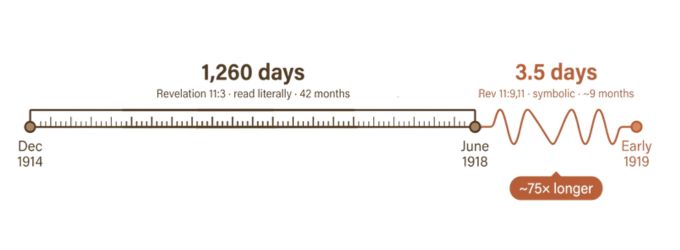
None of these three passages generated the belief. Matthew 24 supplies a role, Malachi 3 supplies a starting point already borrowed from the 1914 doctrine, and Revelation 11 supplies whatever arithmetic is needed to close the remaining gap, with two different rules of interpretation used four verses apart. The belief came first, for reasons the next section covers. The verses were assembled afterward to make it look inevitable.
The verses were assembled afterward to make it look inevitable.
Direct answer: The idea that "the faithful and discreet slave" identifies one exclusive channel didn't come from studying Matthew 24. It came from an 1894 marital and organizational crisis, and the person who invented the reading wasn't Russell. It was his wife.
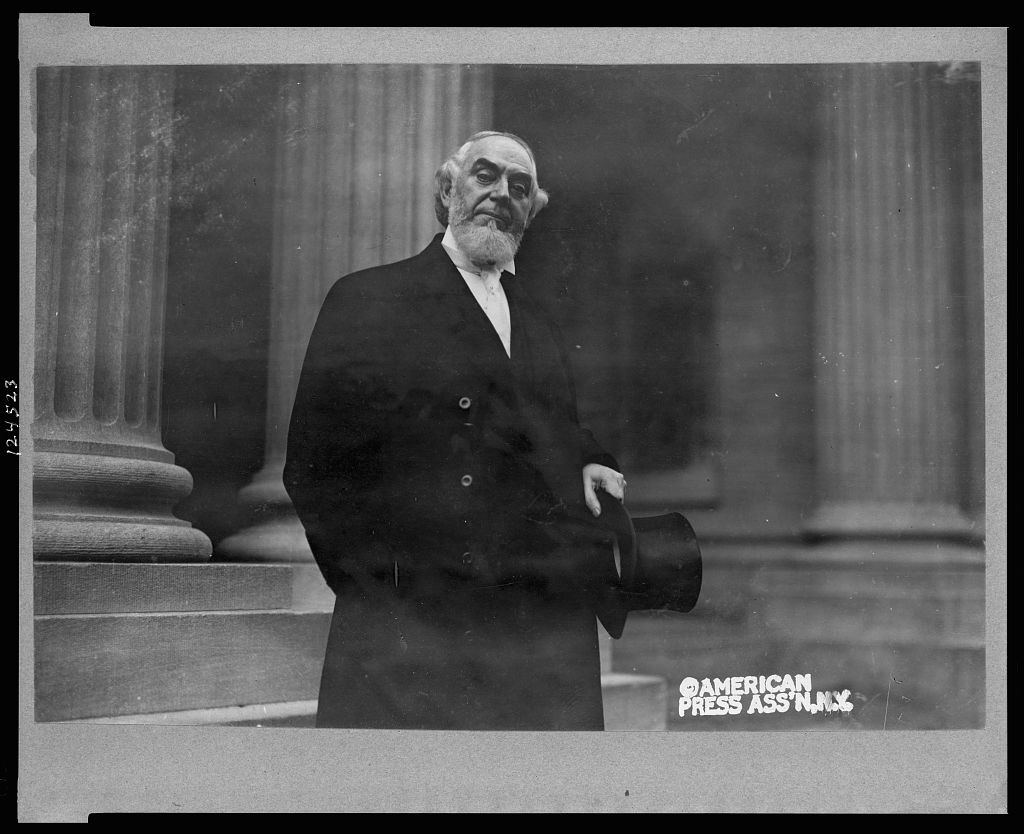
Before 1894, Russell read Matthew 24:45-47 as applying to a class: every consecrated believer, collectively. That year, a faction inside his own organization accused him of running things like an authoritarian. His wife, Maria Russell, at the time an active partner in the ministry, defended him on a speaking tour of Bible Student congregations. Penton's Apocalypse Delayed (pp. 63-64) relies on secondary reconstruction of Watch Tower records from this period rather than directly confirmed primary sources. Based on that reconstruction, he describes her as introducing a new reading of the passage during that tour: since 1878, she argued, the household of faith had been receiving "meat in due season" from one servant.4 Penton's account notes she never said his name directly.
Russell was cautious about picking up his wife's doctrine at first, for the obvious reason: he had just been accused of exactly the kind of self-exaltation this new reading implied about him. The caution didn't last. By 1896 he'd decided the application to himself was reasonable, and within a few years "reasonable" had become "correct," replacing his own earlier reading outright.5 By the time the Watch Tower's December 1916 memorial edition was published, just after his death, it said the quiet part directly: thousands of readers believed Russell himself had filled the office of "that faithful and wise servant."6
That's the doctrine's actual origin story. Not a discovery about Matthew 24. A defense of one man's authority, built by his wife under pressure, that outlived both the marriage and the man, and was still waiting for a date and a set of proof texts twenty-five years later.
Not a discovery about Matthew 24. A defense of one man's authority, built by his wife under pressure, that outlived both the marriage and the man, and was still waiting for a date and a set of proof texts twenty-five years later.
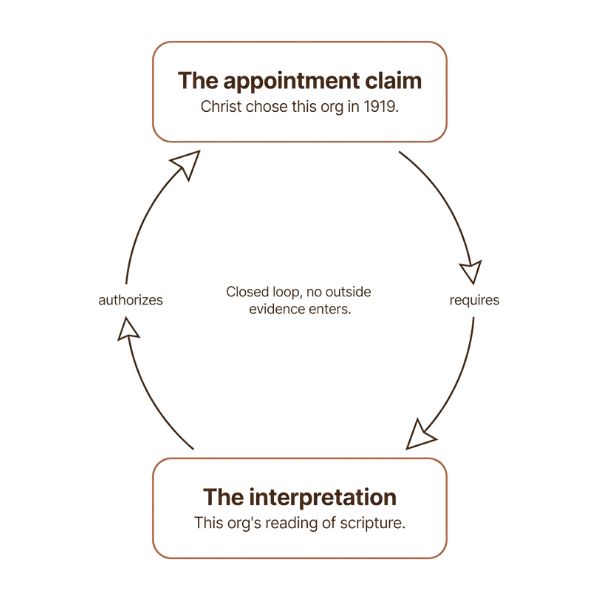
Direct answer: The Watchtower teaches that the Bible can't be properly understood without the organization's own aid, and the claim that the organization was specifically appointed to fill that role is itself just another interpretation of the Bible. That's a closed loop, not independent evidence.
Watchtower literature has stated the premise directly: the Bible "cannot be fully understood without our having the theocratic organization in mind," and that with Watchtower publications, "a much more complete picture of Jehovah's purposes comes into view" than scripture supplies on its own.7 That's exactly what the 1919 doctrine depends on. Readers are told they need the organization's interpretation to understand the Bible correctly, and the specific interpretation they're handed happens to be the one that names this same organization as uniquely authorized.
Run the logic both directions and the problem shows up. Why trust the organization's reading of Matthew 24, Malachi 3, and Revelation 11? Because Christ appointed it in 1919. How do we know Christ appointed it in 1919? Because that's what the organization's reading of those three passages concludes. Nothing outside that loop, no independent sign, no neutral witness, no test anyone outside the organization could apply, confirms either link. The doctrine isn't just under-supported. It's built so that the only evidence for it is the conclusion it's trying to prove.
Direct answer: The group being credited with unique faithfulness in 1919 held doctrinal positions the same organization would later call error, and its devotional practice included things it now calls pagan or unscriptural. If the inspection was thorough enough to disqualify every other religion on earth, it's fair to ask why it didn't disqualify this one too.
On chronology and doctrine, the 1919-era Watch Tower taught:
Christ's invisible presence began in 1874, not 1914. Studies in the Scriptures, Vol. 3, pp. 234-236 sets out this dating, which formed the chronological basis for the organization's teaching at the time.8
Christ had begun ruling in heaven in 1878, based on a parallel to his earthly ministry, not in 1914.9
The chronological basis then in use placed Jerusalem's fall at 606 B.C.E., not 607 B.C.E.10
The "last days" were reportedly understood to have begun in 1799.11
Faithful Bible Students who died before 1878 were taught to have been resurrected in that year, as part of Russell's 1874/1878 chronological scheme.12
The Finished Mystery (1917) predicted worldwide anarchy engulfing every government and church by autumn 1920, a claim discussed in Franz, Crisis of Conscience, p. 217, though the primary pages in The Finished Mystery itself are available for direct verification in digitized editions. It did not happen.13
On devotional practice, the record is just as direct:
Jesus was worshipped. The July 15, 1898 Watch Tower stated the group believed Jesus "was really worshipped, and properly so."14 That position held for roughly sixty years before the July 15, 1959 Watchtower reversed it, stating it is unscriptural "to render worship to the Son."15
Christmas was promoted, not merely tolerated. The December 15, 1903 issue told readers it was "quite immaterial about the date; join in with the world and celebrate Christmas."16 By the late 1970s the position had reversed; the December 15, 1979 Watchtower called the practice "totally inappropriate."17
The cross was worn as a badge of faith. The organization's own 2014 congregational study materials describe Bible Students of this era wearing "a cross-and-crown pin as an identifying badge."18
The Great Pyramid of Giza was treated as a source of chronological proof, with an "inch equals a year" reading applied to its internal passages to defend the group's dating scheme, a teaching not abandoned until 1928 (sourced here via Reed, Answering Jehovah's Witnesses Subject by Subject, p. 190, citing The Watch Tower, June 15, 1922, p. 187; the primary issue is pre-1930 and available for direct verification).19
| Then | Now | |
|---|---|---|
| Date of Christ's invisible presence | In the 1919 era, Watch Tower taught that Christ's invisible presence began in 1874, supported by Studies in the Scriptures, Vol. 3, pp. 234-236. | Jehovah's Witnesses currently teach that Christ's invisible presence began in 1914, not 1874. |
| Date Christ began ruling in heaven | In the 1919 era, Watch Tower taught that Christ began ruling in heaven in 1878, based on a parallel to his earthly ministry. | Jehovah's Witnesses currently teach that Christ began ruling in heaven in 1914. |
| Date of Jerusalem's fall | In the 1919 era, the chronological basis in use placed Jerusalem's fall at 606 B.C.E. | Jehovah's Witnesses currently place Jerusalem's fall at 607 B.C.E., a one-year adjustment made to align with the 1914 chronology. |
| Start of the last days | In the 1919 era, the 'last days' were understood to have begun in 1799. | Jehovah's Witnesses currently teach that the last days began in 1914. |
| Resurrection of pre-1878 Bible Students | In the 1919 era, faithful Bible Students who died before 1878 were taught to have been resurrected in that year, as part of Russell's 1874/1878 chronological scheme. | Jehovah's Witnesses currently teach that the resurrection of faithful anointed ones who had died began in 1918, when Christ came to his spiritual temple for inspection. The 1878 resurrection date plays no role in current teaching. |
| 1920 anarchy prophecy | The Finished Mystery (1917) predicted worldwide anarchy engulfing every government and church by autumn 1920; it did not happen. | Jehovah's Witnesses do not promote this prediction; it is not part of current teaching, though the organization does not prominently publicize its historical failed prophecies. |
| Worship of Jesus | The July 15, 1898 Watch Tower stated that Jesus 'was really worshipped, and properly so,' a position that held for roughly sixty years. | The July 15, 1959 Watchtower reversed this, stating it is unscriptural 'to render worship to the Son,' and this remains the current position. |
| Celebration of Christmas | The December 15, 1903 Watch Tower told readers it was 'quite immaterial about the date; join in with the world and celebrate Christmas.' | The December 15, 1979 Watchtower called Christmas celebration 'totally inappropriate,' and Jehovah's Witnesses currently do not observe Christmas. |
| Wearing of the cross | Bible Students of the pre-1920s era wore a cross-and-crown pin as an identifying badge, as described in the organization's own 2014 congregational study materials. | Jehovah's Witnesses currently reject the cross as a Christian symbol and do not wear or display it in any devotional context. |
| Great Pyramid as chronological proof | The Watch Tower organization treated the Great Pyramid of Giza as a source of chronological proof, applying an 'inch equals a year' method to its internal passages to support its dating scheme, a teaching not abandoned until 1928. | Jehovah's Witnesses no longer use the Great Pyramid as a source of chronological or doctrinal support; it plays no role in current teaching. |
The organization teaches the 1918 inspection was sufficient to disqualify every other Christian denomination. The same standard, applied to the Bible Students' own record, raises a question the doctrine does not directly address: whether the criteria used to disqualify others would, if applied consistently, have disqualified this group as well.
There's a further problem. In 1920, one year after the appointment supposedly took place, the Watch Tower itself asked its readers to affirm that "the person so chosen" as the faithful and wise servant "was Charles Taze Russell," a single man, not a class newly installed the year before.20 Raymond Franz, a former member of the Governing Body with direct access to the organization's internal history, points out exactly what this means: the people supposedly reappointed in 1919 didn't believe anything of the kind had happened, in 1919 or for years afterward. Nobody who was allegedly appointed that year knew it, or believed it, at the time.21 That detail alone should give anyone pause before treating the date as settled history rather than a label added later.
Nobody who was allegedly appointed that year knew it, or believed it, at the time.
Direct answer: When scripture records God commissioning someone for a major role, the pattern is a public, verifiable sign at the time, and Christ's return itself is described as something people see, not something inferred through private calculation. 1919 has neither, and even the doctrine's own explanation for why doesn't hold up.
Being named the sole channel through which the Creator of the universe communicates with humanity is not a minor claim, and scripture's own track record for events on this scale is consistent. When God sent Moses to confront Pharaoh, Moses doubted anyone would believe him, so God gave him public signs on the spot explicitly "so that they may believe that Jehovah... has appeared to you" (Exodus 4:1-9). When Elijah needed to demonstrate whose religion had divine backing, he didn't ask Israel to trust him. He staged a public contest on Mount Carmel and let fire from heaven settle it, in front of the whole nation (1 Kings 18:38-39). Scripture even supplies a direct test for anyone claiming to speak for God: "when the prophet speaks in the name of Jehovah and the word does not come true or come to pass, that is the word that Jehovah did not speak" (Deuteronomy 18:22), a standard the group had already failed repeatedly by 1919, as the dates above show. Even Jesus pointed people to visible evidence rather than his own say-so: "if I am not doing the works of my Father, do not believe me; but if I am doing them... believe the works" (John 10:37-38).
A natural reply is that Christ's return was never meant to be visible in the first place. That's the whole basis of the 1914 invisible-presence doctrine underneath 1919. But that reply runs into the same passages it's trying to explain away. Revelation 1:7 (NWT) reads: "Look! He is coming with the clouds, and every eye will see him." The Greek verb behind "will see," opsetai, is the future middle deponent of horaō, the ordinary verb for physical sight, and the New World Translation itself renders that same verb as literal seeing everywhere else it appears, including John 1:51 (NWT John 1:51 reads: "you will see heaven opened up and the angels of God ascending and descending to the Son of man") and 16:16.22 Matthew 24:30 uses identical visual language for the identical event, and Matthew 24:26-27 warns specifically against claims like this one: "if anyone tells you, 'Here he is, in the inner rooms,' do not believe it. For as lightning... is visible even in the west, so will be the coming of the Son of Man." Acts 1:11 closes the loop: "This same Jesus... will come back in the same way you have seen him go into heaven." He left in a way everyone present could see. The text says he returns the same way. The Watchtower has its own arguments for reading these passages as compatible with invisibility;23 readers can weigh those against the plain wording above.
Put the pieces next to each other and a pattern shows up. The doctrine of a uniquely appointed channel started as a personal defense in 1894, not as a conclusion from the text. The organization's own teaching holds that scripture can't be understood without its aid, and the claim that it was specifically appointed to provide that aid is itself just another interpretation of scripture, a loop with nothing outside it to test either link. The group credited with passing Christ's inspection in 1919 was, by its own later admission, wrong about nearly every major chronological claim it made at the time, and practicing things it now calls pagan. And there's no public sign of the kind scripture's own examples would lead you to expect for a claim this size, only a secular legal case24, and the specific content that triggered it was later removed from the book that caused the charges.
Individually, any one of these might be a footnote. Together, they describe a claim to authority whose content has shifted at several points across a century, including as recently as 2012, when "the slave" was redefined to mean only the Governing Body rather than the much larger anointed class it had meant for decades.
None of that requires a position on scripture itself. It requires a position on one specific, checkable historical claim. Matthew 24, Malachi 3, Revelation 11, and Acts 1 remain available for direct reading, and what those passages say is a separate question from whether any single organization was appointed in 1919 to interpret them on everyone else's behalf.
On that separate question, Matthew 24:45-47 sits inside a run of parables, the ten virgins, the talents, the sheep and the goats, that describe individual readiness rather than institutional appointment. Luke's parallel account has Peter asking directly whether the parable is meant for the inner circle or for everyone, and the answer that follows describes accountability calibrated to what each person knew, not a corporate office assigned at a fixed date (Luke 12:41-48). The same language appears elsewhere applied to individual believers: Paul writes that what is required of a steward is simply to be found faithful (1 Corinthians 4:2), and Revelation promises the crown of life to whoever remains faithful, without naming an organization as the recipient (Revelation 2:10). Hebrews describes an entire list of people who stayed faithful without ever seeing what they were promised, having only "seen it from a distance" (Hebrews 11:13). Read in that setting, the passage describes a posture available to anyone who continues in it while waiting, whether the wait feels near or far, rather than a role one group can hold on another's behalf.
Readers who hold this belief as part of a broader community will weigh these findings in that context.
